See the no-upfront-cost solar options available at your address
The 30 percent federal tax credit for homeowners ended on December 31, 2025. Enter your ZIP code and we will show you what actually replaced it where you live.
- $0 upfront options through a lease or power purchase agreement
- New York's state tax credit of up to $5,000, which uniquely covers leases and PPAs
- New Jersey pays $77 per MWh for 15 years, Connecticut $0.3289 per kWh for 20 years
- Licensed installers only. No door knocking, no pressure, no obligation

The American arm of Solar Panel Funding Ltd, which has helped homeowners find routes into solar in the United Kingdom since 2018. The 4.9/5 Trustpilot rating above is from 7,075 UK customers of the UK company, not from US customers. We have no US reviews yet and will not pretend otherwise. Why we show it anyway.
The honest version
What actually changed, and why it matters to you
The federal credit for buyers is gone
Section 25D ended for any system switched on after December 31, 2025. Deposit date and contract date are irrelevant; the IRS tests the date installation was completed. Buy a system outright this year and there is no federal credit on it.
It moved to whoever owns the system
Section 48E still carries a 30 percent credit, but it goes to the company that owns the equipment. That company can price some of it back into your monthly payment. This is the reason a lease or PPA can cost nothing upfront in 2026, and the reason two thirds of US installs are now structured that way.
Your state still pays, and it varies enormously
New York gives you up to $5,000 against state tax and, unusually, allows it on leases and PPAs. New Jersey pays per megawatt-hour for 15 years. Connecticut runs a 20-year tariff. Florida gives you two tax exemptions and nothing else. Same country, four different answers.
Four ways to pay for solar
Only one of them costs nothing on day one. We show you all four.
Lease or PPA
$0 upfront. A finance company owns the system and you pay monthly, typically 20 to 25 years. Maintenance is usually included.
Solar loan
You own the system and repay a lender. Watch the dealer fee, which the CFPB found typically runs 10 to 30 percent of the cash price.
Prepaid lease
You pay upfront but the finance company still owns the system, so the federal credit is priced into what you pay.
Cash purchase
Lowest lifetime cost, full ownership, and the route hit hardest by the loss of the federal credit.

The part nobody says
If solar is a poor fit for your roof, we will tell you
Roughly speaking, solar is worth doing when your bill is high, your roof faces somewhere near south, and it is not under a tree. When those things are not true, a 25-year agreement is a bad idea and no amount of enthusiasm changes that.
We ask about your bill and your shade at question three and four for exactly this reason. It is cheaper for everyone to find out now. Any site that opens with one big savings number before it knows anything about your house is guessing.
By state
What your state still pays in 2026
These figures come from the utilities and the regulators themselves, not from comparison sites. Several widely-ranking pages are quoting numbers that changed months ago.
| State | Federal credit for you | State incentive | Lease | PPA |
|---|---|---|---|---|
| New York | None since 2025 | 25% state tax credit, capped $5,000. Covers leases and 10-year PPAs | Yes | Yes |
| New Jersey | None since 2025 | $77 per MWh for 15 years, plus full retail net metering | Yes | Yes |
| Connecticut | None since 2025 | $0.3289 per kWh Buy-All, or Netting, both 20 years | Yes | Yes |
| Florida | None since 2025 | No rebate, no state credit. Sales and property tax exempt, 1:1 net metering | Yes | Not permitted |
How it works
Three steps, and you can stop at any of them

1. We call you
You give us a ZIP code and four short answers. We call to talk through your bill, your roof and which of the four routes is worth modeling. Nobody visits at this stage and there is nothing to sign.
2. The installer surveys
If you want a real number, we introduce you to a licensed installer. They measure the roof, design the system and produce the quote, the contract and the warranty. We do not.
3. You decide
You get the state disclosure documents that apply where you live before anything is signed. Read them. They exist because people have been misled in this industry.
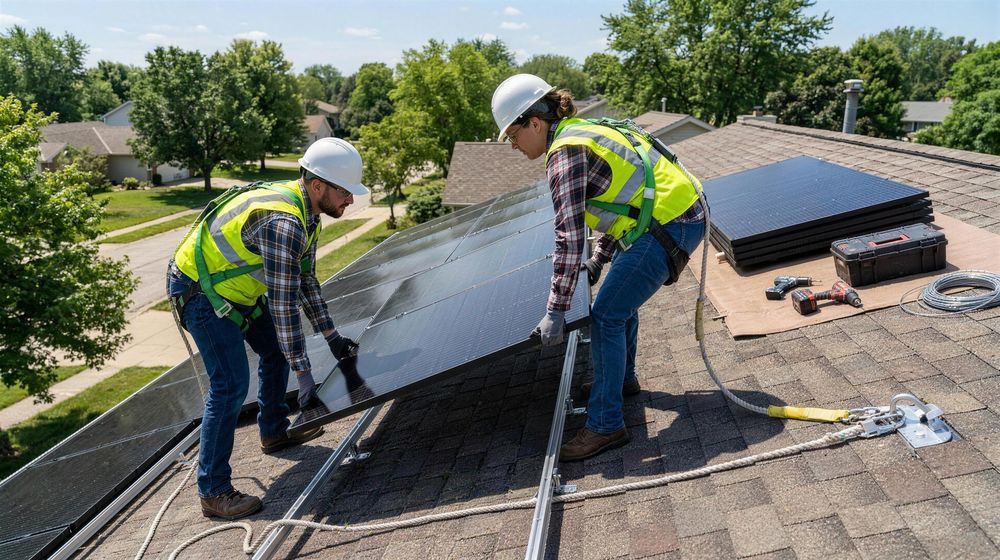
Photography on this site is illustrative and does not depict a specific installation by Solar Funding USA or its partners.
Who we are
We are new in the US. We are not new at this.
Solar Funding USA is the American arm of Solar Panel Funding Ltd, which has been helping homeowners in the United Kingdom find routes into solar since 2018. The UK business is rated 4.9 out of 5 from more than 7,075 reviews on Trustpilot.
Those are UK reviews. They are reviews of the UK company by UK homeowners. We are showing them because you should know who is behind a website asking for your phone number, not because they tell you anything about a solar installation in Cape Coral or Bridgeport. When we have US reviews we will show those instead, and we will say how many there are.
Who actually does the work
Installations in all four states are carried out by Momentum Solar (Momentum Solar LLC, formerly Pro Custom Solar LLC), based at 3096 Hamilton Boulevard, South Plainfield, New Jersey.
Licenses: NYC 2118231-DCWP · NJ 13VH05539000 · CT HIC.0646323 · FL CVC57036
License numbers as published by Momentum Solar, checked August 11, 2026.
FAQs
Questions people actually ask
Is there a government program that pays for solar panels?
What happened to the 30 percent federal solar tax credit?
So how can it cost nothing upfront?
Do you install the panels?
What does it cost me to use you?
Which areas do you cover?
One ZIP code. About a minute.
You will find out which routes are actually open to you, including the ones that are not worth it.